Vintage-Inspired Engagement Rings That Don't Look
Bench notes · The Journal
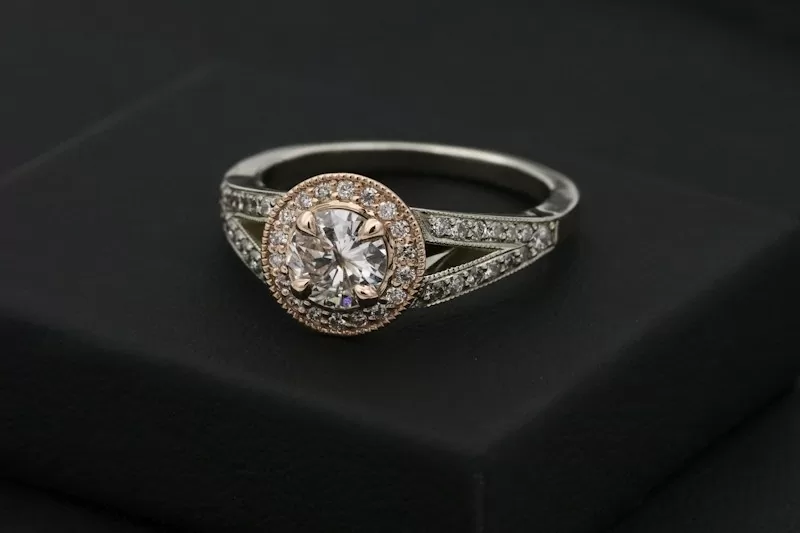
Vintage-inspired is the phrase most clients use when they want "old" without buying a real antique. It is a great instinct. Real antique rings carry sizing limits, worn prongs, and sometimes hidden damage. A well-built reproduction gives you the look with a modern shank that fits and lasts. The problem is that most "vintage" mass-produced jewelry reads as costume within a year, because the details are too uniform, too shiny, and too perfect.
On our bench, the difference between a real vintage-feeling ring and a costume one is in the details that are slightly imperfect.
01Why cheap vintage-inspired rings look fake
Mass-produced milgrain is a tiny, uniform row of beads that looks like a line of bubbles. Real milgrain hand-rolled on a bench is slightly irregular - some beads larger, some smaller, a few close together. Filigree that is stamped looks flat and sharp. Hand-built filigree has depth and a slightly soft edge. New white gold that is rhodiumed to a mirror finish looks modern; a vintage ring has been worn and has a softer surface.
If you want the real feel, build the details by hand and finish them to look lived-in rather than showroom-perfect.
02The cuts that sell the vintage look
Nothing says vintage like an old-cut stone. Old European cuts, old mine cuts, and rose cuts have less sparkle and more warmth than a modern ideal-cut round. They read soft, romantic, and period. If you want a modern diamond but a vintage feel, a cushion or an Asscher cut gets you closer than a round brilliant. Our note on center stone shape for your hand covers how these cuts sit on the finger.
If you specifically want a reproduction of an actual old ring, our piece on vintage ring reproduction walks through how we measure and rebuild an existing antique into a wearable modern piece.
03The details that age well
04The details to avoid
Too many details. A ring with milgrain, filigree, a halo, engraving, and side stones all at once reads as costume because it is over-decorated. Real vintage rings have one or two strong details and a clean shank underneath. We usually cut the design back in the CAD review, and clients thank us later.
Also avoid bright white rhodium on a "vintage" yellow-gold design. Pick a finish that matches the period you are evoking, not the finish that photographs brightest.
05What it costs
Hand-built vintage details take bench time. Milgrain rolling and filigree are slow work. Expect to pay 15 to 30 percent more than a plain modern setting of the same stone. You are paying for the hand finish that separates it from the catalog version. If you want the line items, our custom ring budget breakdown shows where the bench time goes.
06Who it suits
Vintage-inspired suits the client who loves romance, history, and a ring that feels like it has a story before it has one. It pairs beautifully with a plain or slightly engraved band. Our note on engraving what lasts is the right companion, because a vintage ring already invites a date or a short inscription on the inside.
07The finish that sells the period
Most fake vintage rings give themselves away with a mirror polish. Real period jewelry has a soft, slightly worn surface because it was worn. We finish vintage-inspired rings with a light hand-rub rather than a high polish, and we leave the milgrain slightly irregular. We also match the metal to the period: yellow or rose gold for Victorian and Edwardian, platinum or white for art deco. The stone cut carries the most weight. An old European or cushion cut in a hand-filigreed head reads as period from across the room. A modern round brilliant in the same head reads as new. We will steer you to the cut that closes the gap. If you want a faithful copy of a real old ring rather than a mood, our vintage reproduction note covers measuring an existing antique and rebuilding it on a modern, wearable shank. That route gives you the genuine period lines without the worn prongs and sizing limits of a real old ring.
08Bottom line
Hand-rolled details, old or step-cut stones, low profile, one or two strong features, and a finish that matches the period. Skip the mirror shine, skip the over-decoration, and skip the stamped milgrain. Done right, the ring reads as an heirloom, not a costume. Done wrong, it reads as a trend in two years.
The Wikipedia article on rhodium explains why rhodium plating is applied to white gold and silver jewelry.
09Frequently Asked Questions
What ring sizes can you supply in bulk?
US sizes 5–12 including half sizes. Send a size breakdown with your order and we cast to that curve; comfort-fit inner bands reduce resize requests.
Can I order a mixed size run instead of one size?
Yes. Mixed runs are standard for wholesale: specify quantity per size and we pack and label by size at no extra labor cost.
What is the MOQ for custom ring designs?
50 pieces per design for existing molds; 100–300 pieces when a new mold or CAD model is required.
How should I price rings for retail margin?
Most partners use a 3–4x markup on FOB cost for sterling and 2.5–3x for moissanite solos, which keeps landed cost under 30% of retail.
Related reading: How to Choose an Engagement Ring Setting That Actually Lasts, Solitaire vs Halo Engagement Rings: A Bench-Level Comparison, Three-Stone Engagement Rings: Meaning, Design, and Trade-offs.
Send a sketch or a photo — our setter will answer with stone options and a price band.
Talk to the atelier


