Sandcasting vs Lost Wax: Which Casting Method Fits Your
Bench notes · The Journal
If you have ever watched molten metal pour into a mold on a factory floor, you have seen sandcasting. It is the same process used for engine blocks and cookware, and jewelers use it too, though for a very specific kind of piece. Lost wax casting, by contrast, is the method most custom rings are built on. They share the word casting, but the pieces they produce could not look more different. Knowing which method your design calls for changes the quote, the timeline, and the finished texture.
01Sandcasting, briefly
Sandcasting uses tightly packed sand bonded with a small amount of clay or resin. A pattern (often the actual object, or a wood or silicone model) is pressed into the sand to make an impression, the pattern is removed, and molten metal is poured directly into the sand cavity. The sand is then broken open to free the casting.
In jewelry, sandcasting is most often used with natural objects, stones, shells, pebbles, leaves, fossils, pressed straight into the sand. The result is a casting that carries the rough, organic surface of the object itself. You see this in raw-texture gold rings, in pendants cast from actual beach stones, and in men's bands with a granular, unpolished face.
02Lost wax, briefly
Lost wax casting starts with a wax model that is carved, 3D-printed in wax or resin, or injected into a rubber mold. The wax is attached to a sprue, invested in a plaster-like ceramic, and put in a kiln. The wax melts and burns out completely, hence lost wax, leaving a hollow cavity. Molten metal is pulled into that cavity under vacuum or centrifugal force, the investment is broken away, and the casting is cleaned up.
Lost wax can reproduce a detail as fine as a hairline, because the ceramic mold is rigid and smooth. It is how we get pave settings, filigree, milgrain, and sharp, crisp edges. Almost every precision custom ring you have seen came through lost wax.
03Texture and surface
This is the real dividing line. Sandcasting leaves a slightly grainy, uneven surface that follows the texture of the sand. Even after polishing, the metal carries a faint cast skin that reads as organic and slightly rough. That is a feature, not a defect. People who order sandcast pieces usually want that found-object feel.
Lost wax, by contrast, can reproduce whatever the master model had. If the wax was polished to a mirror, the casting comes out near-mirror. If the design called for a satin finish, we apply it after. The casting itself is a blank slate with clean, repeatable geometry.
04Detail and geometry
Sandcasting cannot hold fine, crisp geometry. Thin walls, sharp internal corners, pave seats, and anything smaller than about a millimeter will distort or not fill cleanly. The sand shifts as you pour, and the metal cools unevenly against it. If your design has a delicate gallery, a hidden halo, or prongs under 1mm, sandcasting is off the table.
Lost wax reproduces the master model to within a few thousandths of an inch, which is why it is the default for settings. If your design comes from a CAD render, you are in lost wax territory by definition.
05Cost and repetition
Sandcasting is cheap and fast for a one-off. You press a stone into sand, pour gold, and pull out a pendant. No rubber mold, no burnout, no sprue tree. It is a beautiful process for an artist-driven single piece.
Lost wax has a setup cost. You need a master model, a sprue, investment, and burnout time. But once a rubber production mold is made from the master, you can inject dozens of waxes quickly, which makes lost wax the affordable choice for repeats. If you ever want a matching pendant or a second ring in the same design, lost wax wins every time.
06How we choose
If you bring us a pebble you found on a hike and want it cast in gold, we will sandcast it. If you bring us a CAD design for an engagement ring with a pave halo, we will lost-wax cast it. If you are somewhere in between, a rough-textured band but with a precise center stone seat, we usually combine them: sandcast the shank for texture, fabricate or lost-wax cast the head, and solder them together. The right answer is almost never one process for the whole piece.
07Finishing steps differ too
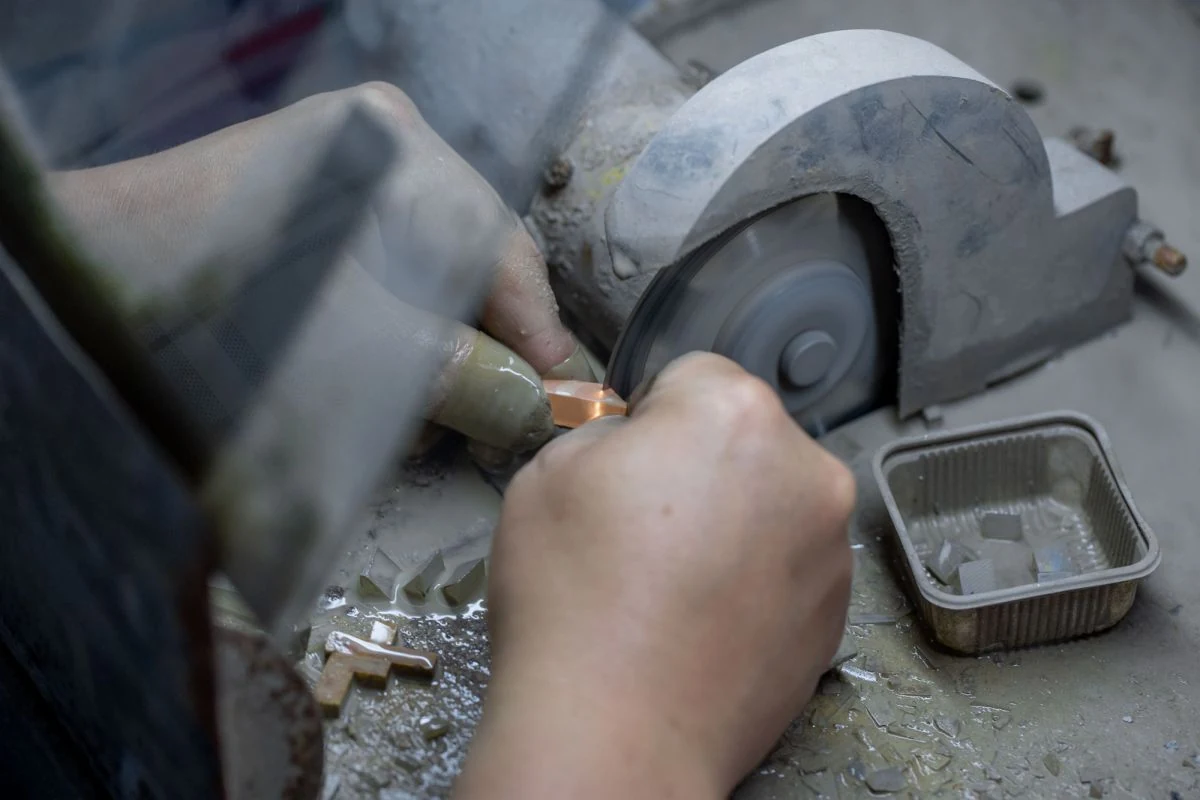
After sandcasting, the piece needs a lot of hand work. We grind off the sprue, file the cast skin, and decide how much of the organic texture to keep. If a client wants a smooth sandcast ring, we essentially lose the whole point; the beauty of the process is that rough surface, so we usually leave a high and low polish, bright on the raised areas and matte in the recesses. That contrast is what makes a sandcast piece feel like a found object.
After lost-wax casting, finishing is more predictable. We remove sprues, steam off investment residue, tumble the piece to knock off the rough cast skin, then move through successively finer polishing compounds. The goal is a clean, even surface that matches the master model. There is no happy accident to preserve; the detail was already in the mold.
Independent background on moissanite — how its hardness and refractive index compare with diamond — is documented in the Wikipedia article on moissanite.
08Related Reading
09Frequently Asked Questions
How do I verify a factory before placing a bulk order?
Request a production video, business license, export records and a paid sample run. A factory that accepts a 50-piece test order is usually a real manufacturer.
What payment terms do you offer?
30% T/T deposit with the balance against the bill of lading. This protects both sides on first orders and can move to net terms after a track record.
What is your normal reject rate?
3–5% under 10x loupe inspection for cast and set pieces. Defective units are replaced free in the next shipment.
Where is the factory located?
Wuzhou, Guangxi, China—the core lab-grown and moissanite manufacturing cluster. Shipments go via Guangzhou or Shenzhen ports.
Related reading: Lost Wax Casting: The Process in Plain English, 3D Printing vs Hand-Carved Wax: Which Model Method Wins for Custom Jew, Custom Jewelry Casting and Setting: Lost-Wax Factory Capacity That Hol.
Send a sketch or a photo — our setter will answer with stone options and a price band.
Talk to the atelier


