Moissanite vs Diamond When You Are Commissioning a Custom
Bench notes · The Journal
01This is not a generic sparkle comparison
Most moissanite (per Wikipedia)-versus-diamond writing fixes on price per carat and fire. That matters, but when you are commissioning a custom ring the decision reaches further: it changes how the setting is engineered, what tolerances the bench works to, which certificate you expect, and how the piece sizes and wears over years. Pick the stone after the design logic, not before.
02Hardness and setting tolerance
Moissanite sits at 9.25 on the Mohs scale, below diamond's 10 but well above sapphire and ruby. Practically, it takes a fine pavé seat and tight prongs without chipping, which is why it sets cleanly in delicate custom mounts. The bench does need slightly different seat prep, because moissanite is a touch more brittle under impact than diamond and an overly aggressive prong seat can crack the girdle. An experienced setter knows the difference; a middleman dropping stones into stock settings often does not.
03Fire, body, and size perception
Moissanite disperses more light than diamond, so it flashes spectral color under bright light. Some clients love that liveliness; others find it reads as "more" than a quiet, icy diamond. The cut grade on the stone controls this - a well-cut round moissanite is balanced, while a cheap stone can look glassy and gray. The other advantage buyers commission around: moissanite of a given visual size costs a fraction, so a client can step up to an oval or emerald cut that would be out of budget in diamond. That is a design upgrade, not a compromise.
04Certification and what to ask for
A natural diamond in a serious commission comes with a grading report (GIA being the reference). Moissanite is graded and documented through GRA-style certificates that list cut, carat, color and clarity. Treat the certificate as a baseline, not a guarantee, and ask the atelier for photos of the exact stone being set rather than a stock image. For boutique buyers, the bigger question is consistency across a run: confirm that every stone in a private-label batch matches color and cut.
05How the choice changes the design
06Which commission suits which stone
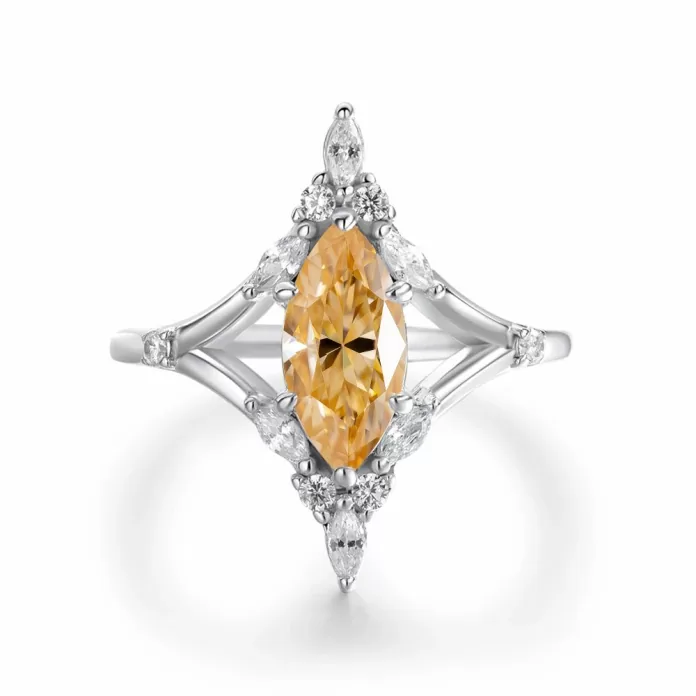
A client who wants the biggest, brightest, design-forward center piece within a clear budget, and who values a conflict-free origin, often lands on a high-grade moissanite set in a sculptural custom mount. A client who wants a quiet, traditional investment stone for a solitaire usually stays with a well-cut diamond. We stock and set both, and you can browse our moissanite rings to see the mounts scaled for the stone before we draw yours.
07The third option: lab-grown diamond
When natural diamond is out of budget but the client wants the diamond look, a lab-grown diamond sits between the two. It is chemically and optically identical to mined diamond, prices lower per carat, and grades through the same reporting language. For a custom mount it sets like a natural stone, with the same seat prep. The trade-off is resale and long-term market perception, which matters for an investment piece but rarely for a ring the wearer intends to keep.
08Sizing and repairs around the stone
A custom ring will likely be resized once or twice in its life. Moissanite should be removed before a resizing that heats the shank, because direct torch heat can damage the stone; the bench pops it out, resizes, and reseats. Natural diamonds tolerate bench heat better but are still protected during work. Ask how your atelier handles resizing around the center stone before you commit, so a future adjustment is not a surprise bill.
For boutique buyers commissioning a private-label line, consistency matters more than a single showcase stone. Ask for a matched lot: stones from the same cut, color and grade, so every ring in the run reads the same on the sales floor. That is a procurement conversation to have before the CAD is approved, not after the first sample arrives.
Whichever stone you choose, the mount should be built for that stone's actual proportions, not the carat number. An oval moissanite and an oval natural diamond of the same weight have slightly different dimensions, and the gallery built for one will not seat the other cleanly. Measure the real girdle and build to it.
Decide the stone type early in the CAD phase. Swapping center stones after a mount is cast means a new setting; swapping them before the render is approved costs you nothing but a few days.
09Related Reading
10Frequently Asked Questions
Is moissanite a good diamond alternative for retail buyers?
Yes for price-sensitive customers who want brilliance and hardness. Moissanite ranks 9.25 on the Mohs scale, holds up to daily wear and costs a fraction of a natural diamond of the same size, so it resells fast in bridal and fashion lines.
What is the minimum order for wholesale moissanite?
MOQ starts at 50 pieces per design for stock items. Custom cuts and private-label settings usually start at 100–300 pieces depending on the mold.
Do you provide certificates with moissanite stones?
Yes. Every parcel ships with GRA or IGI documentation listing carat weight, color grade and cut. We recommend passing the certificate to your end customer for trust.
How long does sample and bulk production take?
Samples ship in 3–5 days. Bulk runs take 15–20 days under 500 pieces, and 25–30 days for custom work.
Send a sketch or a photo — our setter will answer with stone options and a price band.
Talk to the atelier


