Moissanite vs Diamond in a Custom Setting: Where the Cost
Bench notes · The Journal
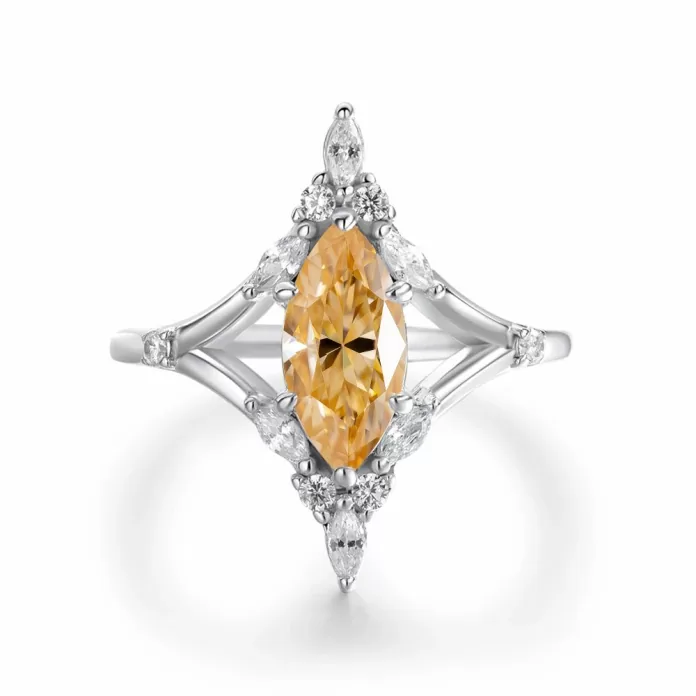
The obvious reason to choose moissanite (per Wikipedia) is price per carat. For custom work, though, the stone is only one line item. The setting, the CAD, the casting, and the setting labor are largely the same whichever center stone you choose. Understanding that split is what lets you make an honest budget comparison rather than repeating a headline price claim without context.
01The stone cost gap
A well-cut, GRA-certified moissanite in a 1 to 2 carat equivalent size typically costs a small fraction of a comparable natural diamond, and materially less than a comparable lab-grown diamond. For a client who wants a two-carat look on a one-carat budget, moissanite is the most direct lever. Moissanite also ranks 9.25 on the Mohs scale, so it is durable enough for an everyday ring, and it does not have the inclusion concerns that can make a low-grade diamond a poor center stone choice.
02What does not change
This is the part many budget calculators miss. The CAD model, the 3D print, the casting, the alloy, the finishing, and the setting labor are charged regardless of what goes in the seat. A custom 14k solitaire setting costs the same to build whether the center stone is moissanite, diamond, or a sapphire. If a quote shows the setting itself at a steep discount when you switch to moissanite, ask whether the design work, the prototype, or the finish has been quietly cut back.
03Where moissanite does affect manufacturing
There are two real differences. First, moissanite's refractive index is higher than diamond's, so light behavior is different: it flashes rainbow more strongly. For clients who want a classic, restrained diamond look, this is a styling note to set expectations about, not a defect. Second, moissanite is often cut to tight calibrated sizes, which can actually make setting faster and more consistent. Work with a supplier who stocks calibrated stones sized to your CAD seat rather than improvising around a loose stone that does not match, because an ill-fitting seat is the most common source of a loose stone later.
04Certification and documentation
A reputable moissanite piece should ship with a GRA or equivalent grading report for the center stone, documenting carat equivalent, cut, color grade, and clarity. For natural diamonds, GIA certification is the standard. Either way, the certificate should match the actual stone. Ask for a laser-inscription check under magnification, and keep the report with the order file. For resale and insurance purposes, moissanite carries a lower intrinsic value than diamond, which is fine as long as the buyer knows that going in and insures the piece for replacement value rather than a speculative resale number.
05The lab-grown middle ground
Between mined diamond and moissanite sits lab-grown diamond, which is chemically and optically identical to mined diamond but priced lower. For a custom commission, lab-grown diamond is worth comparing because it keeps the classic diamond look while freeing budget for a richer setting or a larger size. If the client's hesitation about moissanite is the light performance, lab-grown diamond is the compromise. The decision usually comes down to three factors: budget, how the stone's fire reads to the wearer, and resale expectations.
06A realistic budget split
On a typical custom solitaire, the setting and labor might account for roughly half to two-thirds of the total, and the center stone the remainder. Switching from diamond to moissanite therefore cuts the total bill meaningfully, but not by the headline percentage, because the setting cost stays put. That is still a strong reason to choose moissanite, especially when the savings go toward a richer setting design, side stones, or a larger size that would be unaffordable in diamond. The practical move is to price the setting first, then choose the stone that leaves room in the budget for the finish and side stones that make the whole setting look considered rather than stripped down.
07Side stones and the total look
When the center stone is moissanite, the side stones should be chosen in the same family. Mixing moissanite accents with diamond accents can create a subtle mismatch in fire and brightness that is visible up close, even if the two stones look similar from across a room. Matching both to moissanite keeps the ring reading as one coherent object and protects the budget, because moissanite accents cost far less than diamond accents at the same total carat weight. This is also where the savings from a moissanite center compound: a halo or shoulder of moissanite that would be expensive in diamond becomes affordable in moissanite.
08What to ask the workshop
Moissanite is a legitimate, durable choice for custom work. Just budget it against the full manufacturing cost, not the stone sticker price. Compare options in our moissanite rings.
09Related Reading
10Frequently Asked Questions
Is moissanite a good diamond alternative for retail buyers?
Yes for price-sensitive customers who want brilliance and hardness. Moissanite ranks 9.25 on the Mohs scale, holds up to daily wear and costs a fraction of a natural diamond of the same size, so it resells fast in bridal and fashion lines.
What is the minimum order for wholesale moissanite?
MOQ starts at 50 pieces per design for stock items. Custom cuts and private-label settings usually start at 100–300 pieces depending on the mold.
Do you provide certificates with moissanite stones?
Yes. Every parcel ships with GRA or IGI documentation listing carat weight, color grade and cut. We recommend passing the certificate to your end customer for trust.
How long does sample and bulk production take?
Samples ship in 3–5 days. Bulk runs take 15–20 days under 500 pieces, and 25–30 days for custom work.
Send a sketch or a photo — our setter will answer with stone options and a price band.
Talk to the atelier


