Hand Engraving vs Laser Engraving on Jewelry
Bench notes · The Journal
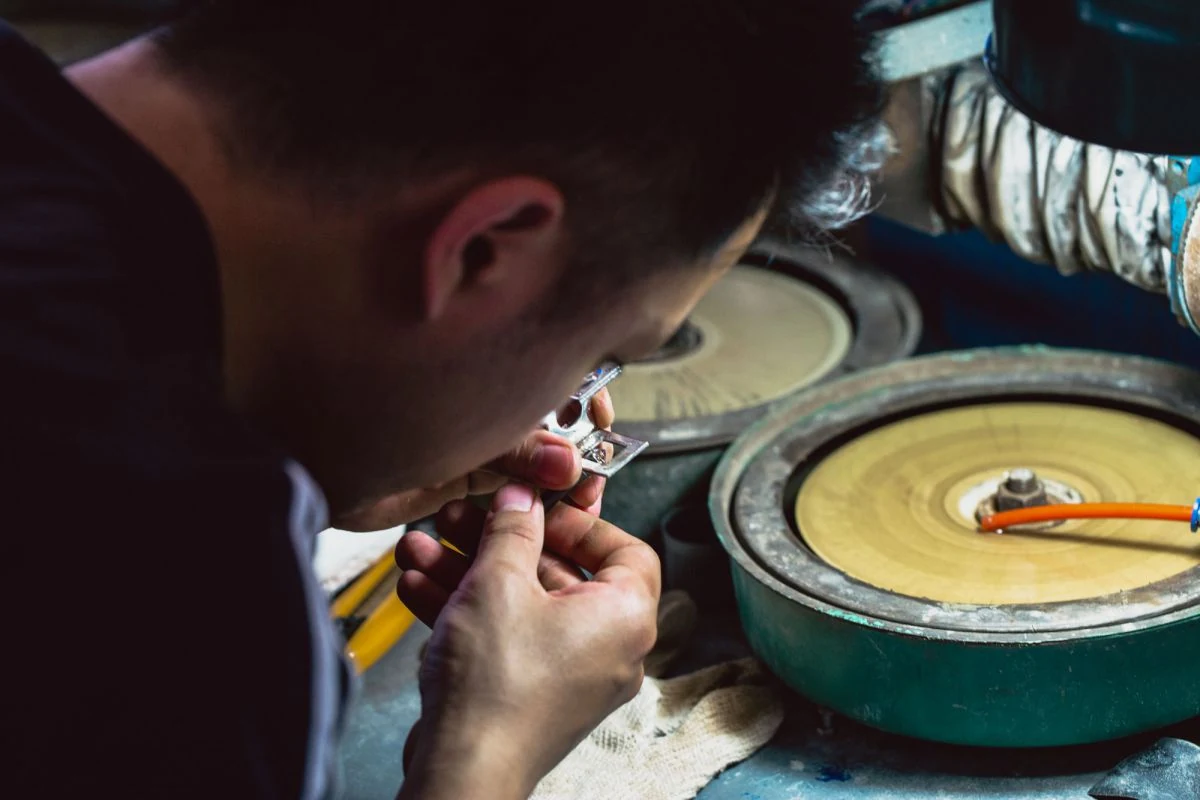
Engraving on jewelry splits into two techniques that people often assume are interchangeable. They are not. Hand engraving uses a sharp graver pushed by hand to cut into the metal. Laser engraving uses a focused beam to vaporize a shallow groove. The difference shows up in depth, warmth, font range, and how the lettering reads ten years later. Choosing between them comes down to what you want the mark to feel like, not just what it says.
01What hand engraving does well
Hand engraving leaves deep, tactile letters with natural variation. A skilled hand engraver can produce flowing script, decorative monograms, and relief work that genuinely looks drawn. Each stroke has weight; curved letters lean; straight lines have slight character. That imperfection is the appeal. Hand-engraved script on a wedding band reads as intimate and human.
Hand engraving is also deeper, so the letters stay legible as the surface wears. A laser mark shallowly vaporized can polish away over years of buffing, whereas a hand cut groove remains. For a piece meant to last generations, hand engraving has a real durability advantage.
02What laser engraving does well
Laser engraving handles detail hand work cannot. Fingerprints, signatures, fine line art, tiny dates, long passages of text—all of these are laser territory. Laser is also fast and consistent: the same word engraved on ten bands looks identical, which matters for corporate gifts or wedding party sets where matching matters.
Laser can engrave harder materials that resist hand gravers, including titanium and many steel alloys. It also costs less than hand work for short texts, because machine time is cheaper than a master engraver’s time.
03Depth, contrast, and legibility
Hand engraving depth runs roughly 0.1 to 0.3 mm depending on technique. Laser runs shallower, often 0.02 to 0.05 mm. On a high-polish surface, both read clearly because the groove catches shadow. On a brushed or sandblasted surface, shallow laser marks can blend in, which is why we usually recommend slightly deeper settings on textured pieces.
Color contrast depends on metal. On white gold rhodium-plated pieces, laser engraving that cuts through to the yellow underlayer produces a natural dark contrast. Hand engraving on the same piece reads as shadow rather than color. Both are attractive; they just read differently. Our note on rhodium plating timing explains why this contrast choice matters.
04Fonts and artwork
Laser can reproduce almost any digital font cleanly, including serif and script styles. Hand engraving adapts fonts to the graver; a hand engraver’s script is their own interpretation, not a digital clone. If you want an exact typeface, laser. If you want the mark to feel like a person made it, hand.
Artwork—a fingerprint, a pet portrait, coordinates—is laser. Hand engraving can approximate illustration, but photographic-grade (per GIA's diamond grading standards) detail is not realistic by hand.
05Cost and timing
Laser engraving is typically faster and cheaper for short, standard texts. Hand engraving is a skilled trade and is priced accordingly, especially for decorative script or monograms. On a custom order, we usually quote both options so you can see the difference. Most clients choose laser for inside-band dates and hand script for outside-band monograms.
06Materials that favor one technique
Softer metals—24k gold, fine silver—take hand engraving beautifully because the graver cuts cleanly without chatter. Harder metals—tungsten, ceramic, titanium—cannot be hand engraved at all; only laser works. Platinum and 18k gold are in the middle: both techniques work, but hand engravers often prefer 18k yellow because it holds a crisp edge, while laser handles all of them equally.
Surface finish also steers the choice. On a high-polish mirror finish, shallow laser marks read softly because there is little shadow contrast. On a brushed or sandblasted surface, the same laser mark can disappear entirely. Hand engraving cuts deeper and shows up regardless of finish, which is why it is the safer choice for textured bands.
07Using both on one piece
Most custom commissions end up combining the two. The inside of the band gets laser-engraved with the date and names—small, precise, not visible. The outside gets hand-engraved script or a monogram—warm, tactile, visible. If you are undecided, this split is usually the right answer, and most engravers are set up to do both in one visit.
08Repair and future changes
Engraving cannot be “undone” easily. To remove it, the metal must be polished away, which thins the band slightly. Adding new engraving over old is possible but looks messy. Choose the wording carefully first. If you are stuck for ideas, our list of engraving ideas covers the messages that age well.
The honest answer is that you rarely have to choose entirely. Most custom pieces end up with laser for the practical fine print inside the band and hand engraving for the visible monogram outside. Used together, they get you detail where detail matters and warmth where warmth shows.
09Related Reading
10Frequently Asked Questions
How do I verify a factory before placing a bulk order?
Request a production video, business license, export records and a paid sample run. A factory that accepts a 50-piece test order is usually a real manufacturer.
What payment terms do you offer?
30% T/T deposit with the balance against the bill of lading. This protects both sides on first orders and can move to net terms after a track record.
What is your normal reject rate?
3–5% under 10x loupe inspection for cast and set pieces. Defective units are replaced free in the next shipment.
Where is the factory located?
Wuzhou, Guangxi, China—the core lab-grown and moissanite manufacturing cluster. Shipments go via Guangzhou or Shenzhen ports.
Send a sketch or a photo — our setter will answer with stone options and a price band.
Talk to the atelier


