Hand-Set vs Machine-Set Stones: What the Bench Actually
Bench notes · The Journal
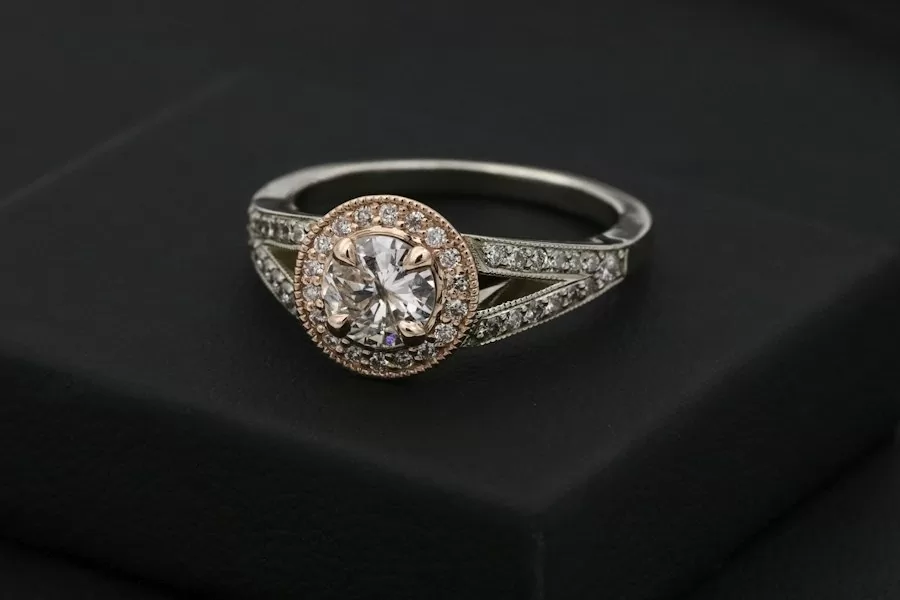
When a production jeweler sets a thousand identical rings a month, the stones go into the setting on a bumper jig or a CNC spindle. The prongs are raised the same height, the seat is milled to the same depth, and the stone drops in with almost no judgment. That is machine setting, and for a repeatable catalog ring it is the right tool.
A custom workshop works the other way around. The stone is chosen first — often a fancy-shape moissanite, an heirloom diamond, or a color we sourced specifically for the piece — and the setting is built to that stone. When the stones finally go in, they are seated by a bench jeweler with a graver, a small burr, and a push stick. The machine never meets the ring.
01What machine setting is actually good at
There is nothing wrong with machine setting. On a production ring where every center stone is the same round brilliant and every head is cast to a standard die, a machine can seat fifty stones an hour with even prong pressure. The risk of a lopsided ring is low because the part itself is uniform. Factory-direct catalog pieces rely on this speed, and it keeps the price sane.
Where machine setting falls apart is when the inputs vary. A cushion moissanite with a slightly off-square outline, a pear that leans, a stone with an unusually thick girdle — none of these sit cleanly in a generic jig. The machine presses the same way every time, which means it presses wrong every time. That is when you see tilted stones, uneven prongs, or a seat that is either too deep or too shallow.
02What hand setting changes on the bench
A bench jeweler starts by looking at the stone under magnification. They measure the girdle, check the culet, and note where the widest part of the outline falls. Then they cut the seat — the small ledge the stone rests on — to that stone, not to a drawing. The burr goes in, the seat is test-fitted, the burr goes back in, and the stone is dropped in again. A typical seat takes ten to twenty minutes, and that is before any prong is pushed over.
Once the stone sits level and stable, the prongs are pushed one at a time. The bench jeweler alternates opposite prongs so the stone does not shift. Each prong is then shaped with a cup burr and finished with a burnisher. The goal is a prong that grips the stone, sits flush against the crown, and does not catch on a sweater. That last part is where most of the time goes.
03Where the accuracy actually shows up
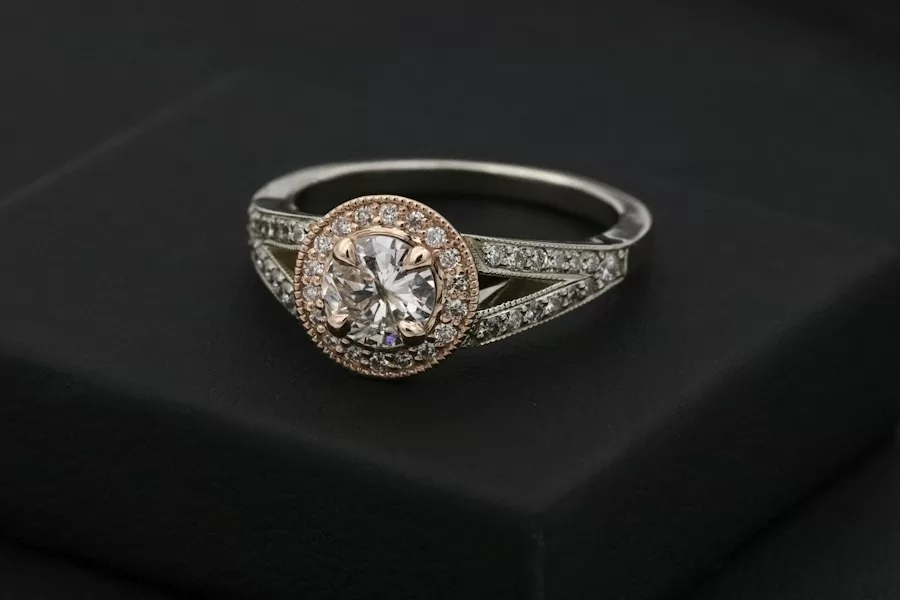
You can see the difference without a loupe. A hand-set stone sits dead level in the head. The prongs are even in height and evenly spaced around the stone. When you run a finger across the top, nothing catches. A machine-set piece that was forced — because the stone did not match the jig — shows a tilted table, one prong lower than the others, or a seat that leaves the stone rattling.
Accuracy also means safety. A stone that is seated too shallow can work loose over a year of wear. A prong that is pushed too far over the crown can chip a moissanite's facet edge. Hand setting trades speed for control of both.
04What about the accent stones?
On a custom piece with small accent stones along the shoulders, we often machine-set the accents and hand-set the center. The accents are uniform round brilliants or melee that fit a standard jig, so machine setting is fast and consistent. The center stone — the one you chose specifically — gets the hand treatment. This is how most custom workshops balance cost and craft, and it is why a custom ring can still come in at a sane price.
You can ask the workshop which stones are hand-set and which are machine-set. A reputable bench will tell you openly. If the whole ring is machine-set with no hand finishing, you are paying a custom price for a catalog build, and you are better off buying catalog.
05Does it cost more?
Yes, but not as much as people expect. On a custom piece, the setting time is already a line item in the build. The marginal difference between a hand-set stone and a rushed machine-set one is usually a half hour to an hour of bench time, not a separate premium. The piece that really pays for hand setting is the one with a fancy shape, a non-standard head, or a stone you cannot replace.
If you are choosing between a catalog ring that was machine-set and a custom ring that was hand-set, the decision is mostly about the stone and the design. But if you are already building a one-off — see how we walk through a first custom design consult — hand setting is the default, and it is the reason your center stone stays put for the next decade.
Independent background on moissanite — how its hardness and refractive index compare with diamond — is documented in the Wikipedia article on moissanite.
06Related Reading
07Frequently Asked Questions
How do I verify a factory before placing a bulk order?
Request a production video, business license, export records and a paid sample run. A factory that accepts a 50-piece test order is usually a real manufacturer.
What payment terms do you offer?
30% T/T deposit with the balance against the bill of lading. This protects both sides on first orders and can move to net terms after a track record.
What is your normal reject rate?
3–5% under 10x loupe inspection for cast and set pieces. Defective units are replaced free in the next shipment.
Where is the factory located?
Wuzhou, Guangxi, China—the core lab-grown and moissanite manufacturing cluster. Shipments go via Guangzhou or Shenzhen ports.
Send a sketch or a photo — our setter will answer with stone options and a price band.
Talk to the atelier


