"How long will this take?" is the second question every client asks, right after "how much?" The answer we usually give is six to eight weeks, and it frustrates people. They want a number they can put on a calendar, not a range. So let me give you the real version, week by week, of what actually happens inside our workshop after you say yes to a design. Once you see the steps, the timeline stops feeling like a delay and starts feeling like the minimum the ring actually needs.
Every custom ring is different. A simple solitaire in a stock setting can move faster. A hand-carved vintage reproduction with accent stones will move slower. But the structure below is the spine of almost every piece we make, and it is the reason promising a two-week turnaround is a promise we will not make. Rushed jewelry leaves the bench looking fine and fails on the finger.
Week one: the consultation and the order
Most of week one is not metalwork at all. It is conversation. We sit down with you, look at your inspiration photos, talk about how you live in your rings, and pin down the details that actually matter: the center stone, the metal, the band width, the profile, the finish, and any engraving or texture. We take a finger size, and if the ring is a surprise, we work with whoever knows your size to get it as close as possible. We also photograph the stones you might be setting, whether you are supplying family diamonds or choosing from our stock.
By the end of week one you leave with a written quote and a clear scope. We have not touched a file yet. This feels slow to clients, but skipping it is how rings come back wrong. A twenty-minute design conversation saves a week of rework later.
Week two: design and CAD
Once the scope is locked, we move to design. For most modern rings we build a 3D model in CAD. This is not a sketch. It is an exact digital copy of the ring, scaled to your finger size, with the center stone measured and seated in a setting that actually fits its proportions. You see renderings from several angles, and this is your chance to push back. The band too thick? The prongs too prominent? This is the cheap moment to change it. Altering a CAD model takes an hour. Altering a wax print or a cast ring takes days, and altering a finished ring costs real money.
For carved or vintage work, our goldsmith may start by hand-carving a wax rather than designing in CAD. Either way, by the end of week two you approve a model you have actually seen, and we know the piece we are about to make.
Week three: printing and casting
Approved, the model goes to print. We print the ring in a high-resolution wax-like resin, check it against the stone, and then cast it. Casting is the moment the digital or wax model becomes real metal. The wax or resin is encased in a plaster investment, burned out in a kiln, and replaced with molten gold or platinum. When the flask is broken open, out comes a rough, orange-metal-looking ring with a tree of sprues attached, fresh from the mold.
This step is where delays creep in if a stone is late. If the center stone is still being sourced or certified, casting waits. We try to have every stone in hand before we cast, because casting a setting that does not fit the stone is the classic beginner mistake. We have learned the hard way. This is also why a ring with a commissioned or certified stone can stretch to eight or nine weeks rather than six.
Week four: filing, soldering, and the first rough clean-up
The casting sprue is cut off, and the ring goes through its first bench work. The goldsmith files away casting marks, solders on any parts that were cast separately, rounds the shank, and gets the ring to a point where it looks like a ring, not a casting sprue. At this stage it is matte, rough, and slightly lumpy. It is also when we check the ring against your finger size. Casting shrinks slightly, and we want to know early whether we have size correction to do before stones go in.
This week is the invisible week. Clients see almost nothing that looks like jewelry yet. But it is the week that determines whether the ring sits straight on the finger or wobbles. We spend more time here than clients expect, because a band that is not perfectly round and level will never sit right, no matter how well it is polished later.
Week five: stone setting
Now the stones arrive at the bench. The goldsmith seats the center stone, checks its girdle against the seat we cut, and bends the prongs over it one by one. Accent stones, if there are any, follow. Setting is the most delicate work in the whole process. A prong closed too tight can chip a stone. A seat cut too deep can leave a stone sitting too low. We take our time here, because a center stone that falls out on week three of marriage is the one email we never want to send.
After setting, we check every stone with a prong tester and under magnification. We also check that nothing is loose before the ring moves to polishing. This is a QC gate, not a formality.
Week six: polishing, plating, and finishing
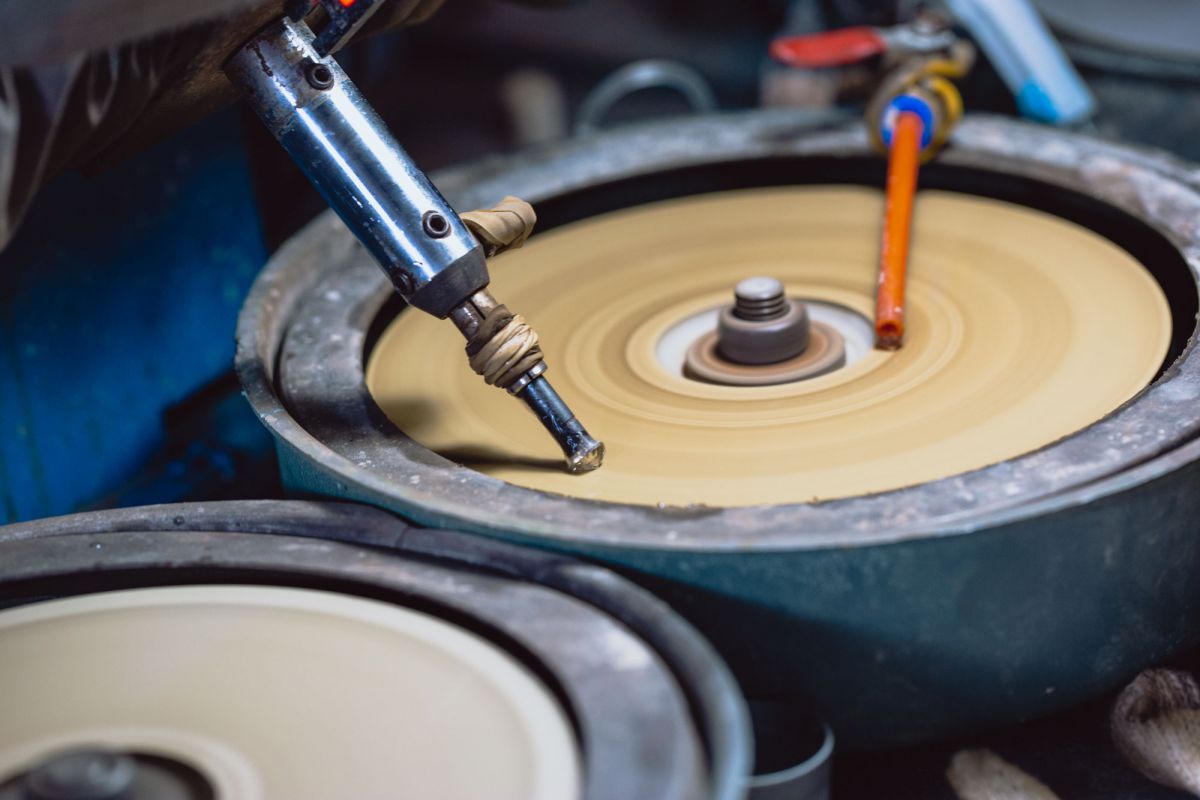
Setting leaves tool marks and fingerprints. Now the ring is polished. We polish it in stages, moving from coarse abrasives to finer ones, until the metal has the finish you chose, high shine, satin, or brushed. White gold rings go to rhodium plating at this point, which gives them that bright white surface. Engraving, if you chose it, is usually done just before the final polish so the letters stay clean and sharp rather than wearing away under the buff.
This is the week the ring finally looks like the piece you imagined. It is also the week we photograph it for our records and do a final fit on a mandrel in your size. If the size is off, we correct it now, before the stones are fully settled and before the plating goes on.
Week seven: inspection, cleaning, and your hand
The last week is quiet on purpose. The ring gets a final inspection under magnification: prongs tight, stones seated, engraving clean, plating even, band round and level. We clean it ultrasonically, steam it, and box it up. We also prepare the paperwork: the paperwork on the stone if it is certified, the care notes, and a note on when to bring it back for a check-up.
When you come in, we size it on your hand, adjust if needed, and show you how to look after it. This last fitting matters. A ring that was perfect on a mandrel can feel different on a real finger that swells through the day, and we would rather fix that now than have you wear a ring that pinches.
Why rush week is a bad week
Clients occasionally ask us to compress this to three or four weeks for a proposal deadline. We say no more often than yes. The steps cannot be safely shortcut. Casting takes the time casting takes. Setting a stone under time pressure is how prongs get bent and diamonds get chipped. Polishing that is rushed leaves swirl marks under the surface. The ring will look fine on day one and tell the truth a year later when a prong loosens.
If your deadline is real, the smart move is to start earlier, not to compress later. Build the ring for the date you actually have. A proposal in mid-December should mean a kickoff by late October. That is the difference between a ring you love for decades and a ring you bought in a panic.
A short timeline to plan backwards from
When you set a date, count backwards like this:
- Eight weeks out: first consultation, decide metal and stone.
- Six weeks out: approve CAD or wax, order any stone that needs sourcing.
- Four weeks out: casting and bench work underway.
- Two weeks out: stones set, polishing and plating.
- One week out: final inspection, cleaning, fitting on your hand.
Stick to that rhythm and the ring will arrive ready, not rushed. The weeks are not us taking our time. They are the steps a real piece of jewelry actually needs to become something you will never want to take off.
Where the delays actually come from
When a ring takes longer than the promised eight weeks, it is almost never because the goldsmith is slow. It is one of a small handful of predictable bottlenecks, and knowing them helps you plan. The first is the stone. If you have chosen a certified diamond that has to be shipped from a grader, or a specific antique cut that we have to source, the clock waits on that stone. We cannot cast the setting until the stone is in hand and measured, because casting a setting for a stone that has not arrived is how you end up with a seat that does not fit.
The second bottleneck is design revision. The CAD process is fast on our end, but slow on the client end, because decisions happen around work and family schedules. A client who takes a week to approve a rendering adds a week to the timeline. We nudge gently, but we also respect that a big decision deserves a careful look. The third bottleneck is holidays. A ring that lands in the shop before a long weekend, or before the Christmas shutdown, pauses while the bench is closed. We plan around it, but it adds up.
What you can do to keep it on schedule
Clients who have a smooth experience do a few simple things. They respond to rendering approvals within a couple of days rather than letting them sit. They have their finger size locked, or the ring measured on someone who knows it, before we start. They choose stones we already stock, or they understand that a sourced stone adds time. And they tell us the hard deadline up front, so we can build in a cushion rather than discover the proposal date halfway through.
We send photos at the major milestones: when the casting comes out, when the stones are set, when the ring is polished. You do not have to wait until week seven to see progress. Those check-ins also give you a chance to flag anything that looks off early, when it is still cheap to fix.
What happens if you need it faster
If your deadline is immovable, we will tell you honestly whether we can hit it. If the design is simple and the stone is in stock, we can sometimes compress to four or five weeks. If the design is complex or the stone needs sourcing, we will not promise what we cannot deliver. In those cases we offer the alternatives: a simpler setting, a stone we already have, or a beautiful off-the-shelf piece we can customize with engraving overnight. We would rather hand you a good ring a week early than a rushed ring on the wrong day.
A note on the first fitting
The week seven fitting is not a formality. A ring that is perfect on a mandrel can feel different on a real finger that swells through the day, and we want to catch that now. If the size needs a small tweak, we do it before you wear it daily. If the finish feels too shiny or too matte, we adjust it. This is the last chance to make the ring feel like yours, and we take it seriously. By the time you walk out with the box, the ring has been checked on a real hand, not just a metal stick.