Bespoke Custom Earring Design Service Process
Bench notes · The Journal
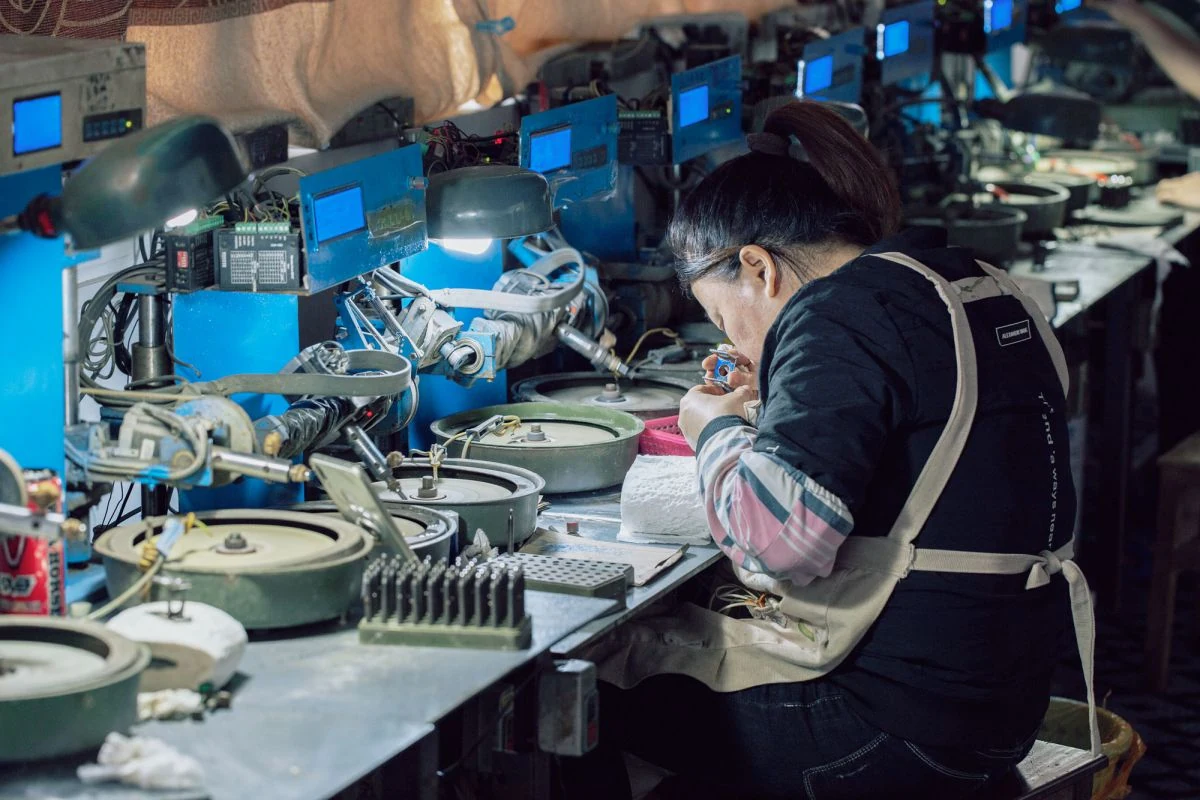
Earrings are the most personal piece of jewelry most people own. They sit in a piercing you chose, in a position you see every time you look in a mirror, and they frame your face in every photograph. Unlike rings, which are looked at mostly from the top, or necklaces, which hang below the face, earrings are viewed from every angle—front, profile, three-quarter, from behind when you turn your head. A poorly designed pair of earrings will look wrong from a direction you did not design for; a well-designed pair will look intentional from every angle.
HOLYCOME has designed and manufactured over 1,800 pairs of bespoke earrings for private clients and partner jewelry brands since 2016, working from our Guangzhou factory with the same design team that handles our bespoke engagement ring clients. Bespoke earrings cover a wider range of forms than bespoke rings—studs, hoops, huggies, drops, chandeliers, jackets, climbers, cuffs, threaders, ear crawlers, mismatched pairs, multi-piercing sets—and each form carries different design constraints. This article walks through our bespoke earring design process, from first consultation to finished pair, and covers the decisions you make at each stage, pricing, lead times, and how to start.
01Why Bespoke Earrings Are Different from Catalog Earrings
Most retail earrings are designed to look good on a mannequin in a display case or on a product photo. Bespoke earrings are designed to look good on your ears (or your customer's ears, if you are a brand commissioning a collection). That sounds obvious, but ear anatomy varies enormously—earlobe thickness, earlobe position (attached vs detached), the angle of the ear relative to the face, the cartilage shape of the upper ear, the position of piercings—and these differences change how an earring sits.
Three design issues come up repeatedly in retail earrings that bespoke design solves:
- Drop balance: Drop and dangle earrings that tip forward instead of hanging straight. This happens when the center of gravity is ahead of the post (designers place decorative elements forward for visibility, but this tips the earring away from the ear). Bespoke drops are balanced so the center of gravity sits directly below the post.
- Post length mismatch: Most stock studs come with 10–11mm posts, which works for average lobes but is too short for thick lobes (the clutch does not go on fully), too long for petite lobes (the post sticks out visibly behind the ear), and too short for jackets (which need 13mm+ posts to accommodate the jacket plus lobe). Bespoke posts are specified to your earlobe thickness.
- Huggie/hoop diameter mismatch: Huggies come in standard diameters (10mm, 12mm, 14mm), but everyone's earlobe attachment point is slightly different. A 12mm huggie that sits perfectly on one ear will be too tight (pressing into the lobe) on another or too loose (gapping) on a third. Bespoke huggies are sized to your earlobe measurements.
02The Bespoke Earring Design Process: Seven Stages
Stage 1: Consultation (Free, No Obligation)
As with rings, the process starts with a 30–45 minute consultation, but the questions are different:
For clients designing for multiple piercings (the curated ear trend), we ask for a photograph of the ear so we can map piercings and design a set that works together across all positions. You get a written brief and firm quote after the consultation.
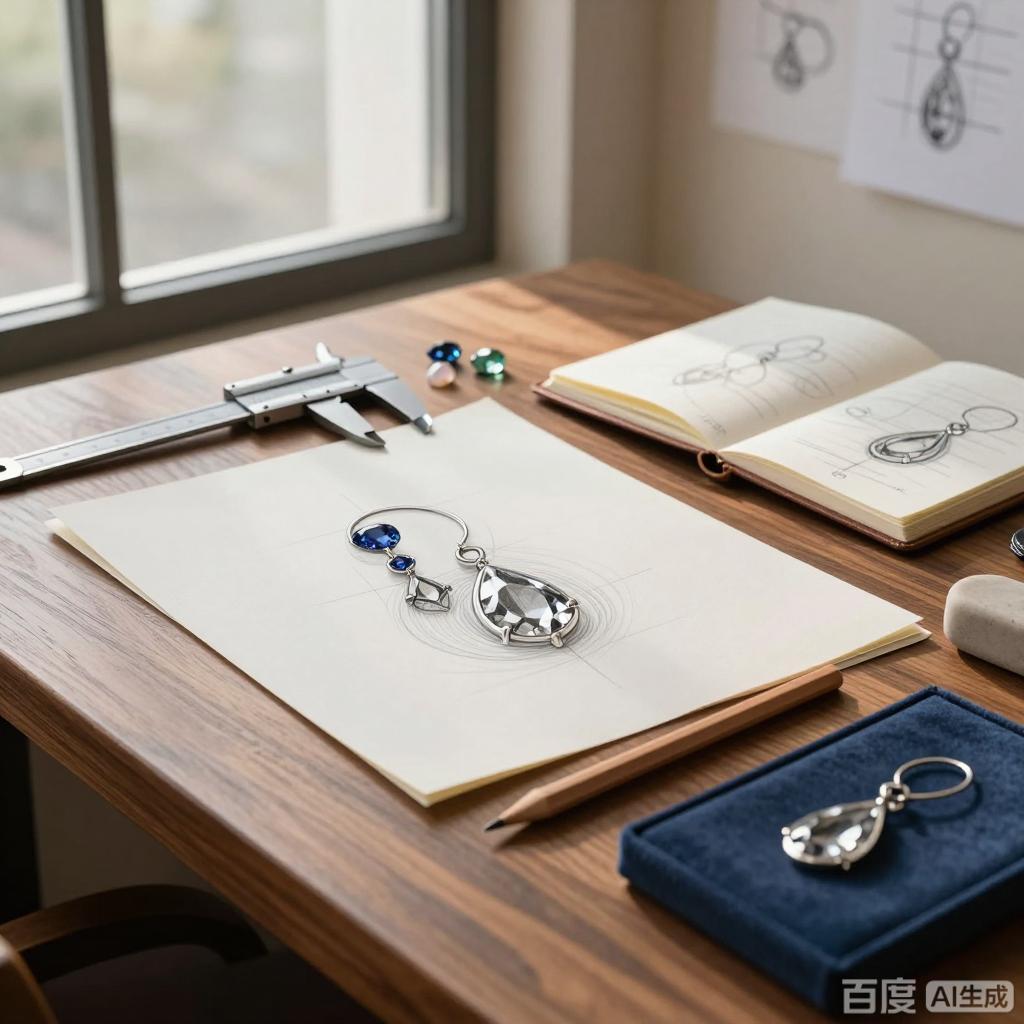
Stage 2: Concept Sketches (2–5 Days)
After paying a $200 design deposit (credited to the final piece), our designers produce 2–3 concept sketches per earring style. For multi-piercing sets, we sketch the ear as a whole, showing how all pieces work together at actual scale on an ear profile. Common concept directions:
- Single hero stud + complementary pieces: A statement stud (large stone or distinctive form) for the first lobe piercing, smaller coordinating huggies/studs for other piercings.
- Matching symmetry: Identical pieces in decreasing sizes for multiple lobe piercings.
- Asymmetrical pairs: Different left and right designs that complement each other (a drop on one ear and a stud on the other, for example).
- Crawler/climber concepts: Elongated pieces that travel up the ear curve—these require the ear photo to design for actual ear shape.
Stage 3: CAD Design and Renders (5–8 Days)
Earrings are designed as matched pairs in Rhino/MatrixGold with special attention to symmetry and balance. Key CAD specifications for earrings:
- Post length, thickness, and material (matching alloy, titanium upgrade, or surgical steel for sensitive ears).
- Post position (for drops/dangles—positioning determines how the earring hangs).
- Clutch type (friction butterfly, silicone push-back, screw-back, lever-back, omega clip—see clasp discussion below).
- Weight target (a single earring over 4g will pull on the lobe and stretch the piercing over time—we flag heavy designs before production).
- Bail/connection point for drops (jump ring, fixed loop, chain link—different connections produce different movement).
- Hinge and closure design for huggies/hoops (notched-post tension, safety latch for large hoops).
- Pair matching tolerance (stones within one color/clarity grade, metal weight within ±0.05g per ear).
You receive 4–6 renders per pair (front, profile, three-quarter, worn on an ear render, back view showing posts and clutches), plus dimensioned technical drawings. Two rounds of CAD revisions are included.
Stage 4: 3D Wax Prototype (Optional, 3–5 Days)
For $20–$40 we ship a 1:1 resin prototype of the earring (both pairs) so you can hold it up to your ear and check size, proportion, and how it sits. This is especially valuable for crawlers, climbers, cuffs, and large hoops—pieces where proportion relative to the actual ear is hard to judge from renders. It is less critical for standard studs and small huggies.
Stage 5: Stone Sourcing (Runs in Parallel, 5–10 Days)
As with rings, we source stones to your brief and present options with full certification. For earring pairs, stone matching is more strict than for solitaire rings—both stones must match in color, clarity, size, and face-up appearance because they are viewed side by side at close distance. We match pairs by eye under D65 daylight lighting, not just by certificate.
For earring jackets (decorative elements worn behind the lobe with a stud passing through), we coordinate stone sizing so the stud stone sits proportionally relative to the jacket halo.
Stage 6: Production (10–18 Days)
Production follows the same casting/setting/polishing workflow as rings, but with earring-specific quality steps:
- Matched-pair casting: Left and right pieces are cast on the same wax tree in mirror orientation for identical alloy grain and finish.
- Post attachment: Posts are laser-welded (gold) or soldered (silver) and pull-tested at 2kg vertical pull per ear. Cold-solder joints are the #1 cause of earring failure—we catch them at this stage.
- Setting: Stones are set, with pairs matched by eye at the setter's bench as stones are placed (setters have access to a larger pool of melee and can swap stones to achieve the closest possible match).
- Clutch fitting: Clutches are fitted to posts and tested for grip—slides on smoothly, holds firm when tugged.
- Hinge assembly and cycle testing: For huggies/hoops, hinges are assembled and the piece is opened/closed 20 times to confirm smooth operation and secure closure.
- Polishing and finishing: Final finish per specification; edges polished smooth (no sharp edges that contact skin or catch hair); rhodium plating for white gold/silver.
- Final QC: Pair matching check under daylight LED, weight confirmation per ear, post straightness against jig, clutch function, hinge cycle test (if applicable), stone tightness, engraving check (if specified), hallmark stamping.
Stage 7: Photography, Shipping, and Care (2–5 Days)
We photograph finished earrings from multiple angles (on a white background, on an ear model) before shipping, and send you the photos for approval before dispatch. Earrings ship in a branded presentation box (or your custom packaging) via DHL/FedEx fully insured, with certificates for any certified stones, care cards, polishing cloths, and extra clutches (one spare per pair, more on request). Bespoke earrings include the same lifetime care as our rings: complimentary annual polish, prong inspection every 2–3 years, and clutch replacement as needed.
03Clutch and Closure Decisions
The clutch you choose affects both security and wearability. We help clients choose based on earring weight and value:
| Clutch type | Security | Best for | Cost add (per pair) |
|---|---|---|---|
| Silicone push-back (our default) | Good | Most studs and light drops under 3g per ear | Included |
| Screw-back | Very high | High-value studs with stones over 0.50ct | +$1–$2/pair |
| La Pousette (spring-loaded) | Highest (industry safety standard) | Premium diamond/lab-grown studs | +$3–$6/pair |
| Lever-back (hinged French hook) | High | Drop and dangle earrings | +$0.50–$1/pair |
| Omega clip (paddle clip) | Medium (non-pierced or stabilizer) | Non-pierced ears, heavy drops as stabilizer | +$1–$3/pair |
For huggies and hoops: notched-post hinge closure for small huggies (8–15mm), latch-back with figure-8 safety for larger hoops (20mm+). All huggies/hoops are cycle-tested 20 open/close cycles before shipment.
04Pricing and Lead Times
| Order type | Price range (pair) | Lead time |
|---|---|---|
| Simple bespoke studs (14K gold, small diamonds/moissanite, no complex design) | $600–$1,500 | 3–4 weeks |
| Bespoke huggies/hoops (gold or platinum, plain or diamond-set) | $800–$3,500 | 4–5 weeks |
| Bespoke drops/dangles (gold, diamond/colored stone) | $1,000–$4,000 | 4–6 weeks |
| Chandeliers and complex multi-stone pieces | $2,500–$10,000+ | 6–8 weeks |
| Curated multi-piercing earring sets (3–5 pairs per ear) | $2,000–$8,000 | 5–7 weeks |
| Bridal earring sets (bespoke, paired with engagement ring/wedding band) | $1,500–$8,000 | 5–8 weeks |
| Silver bespoke earrings (sterling silver, fashion price point) | $150–$600 | 3–4 weeks |
The $200 design deposit covers sketches, CAD, and two rounds of revisions; it is credited toward the final piece. Rush production (2–3 weeks) is available for +$200–$400. Clients providing their own stones receive the same service, with stone insurance during our possession.
05Specialized Earring Projects
We handle several specialized bespoke earring categories beyond standard studs and hoops:
06FAQ
Do I need to know exactly what I want before the consultation?
No. Most of our clients come in with Pinterest boards, a few saved Instagram posts, a general sense of what they like, and a budget—not a fully-formed design. That is exactly what the consultation is for: we ask questions, show examples, narrow down the direction, and present you with sketches. You don't need to be a designer; you just need to know what matters to you.
Can you make earrings for people with metal allergies?
Yes. For clients with nickel sensitivity, we use titanium or surgical steel posts press-fit into the earring body (the post is the only part that passes through the piercing). Our gold alloys are nickel-free (we use palladium-alloyed white gold, not nickel-alloyed white gold, for EU and sensitive-skin clients). Platinum is naturally hypoallergenic. We can also produce complete earrings in titanium (with gold accents via anodizing), though titanium cannot be cast the same way as gold and requires different production.
Do you make clip-on earrings for non-pierced ears?
Yes. Any stud, drop, or jacket design can be converted to clip-on with omega clips (paddle clips), screw-adjustable clips, or magnetic clips. Clip-on converters add $1–$3 per pair depending on clip type. Converting heavier drops to clip-on often requires additional counterweight design so the earring does not tip forward.
Can you design a full curated ear set (multiple piercings)?
Yes. Curated ear design is one of our favorite projects. We work from a photograph of your ear (or your customer's ear), mark each piercing position, and design pieces that work together in scale, style, and metal tone across all positions—typically a hero piece for the first lobe, smaller pieces for second/third lobes, and huggies/cuffs for cartilage positions. Multi-piercing sets are designed as a cohesive collection so nothing looks like an afterthought.
What if I don't know her earlobe thickness or piercing positions?
If you are designing a gift and don't have easy access to measure, we default to average specs: 10–11mm post length for lobes, 12mm huggie diameter, silicone push-back clutches, and standard 7mm stud size. These are one-size-fits-most defaults that work for roughly 80% of wearers. After gifting, we offer complimentary post shortening/lengthening or clutch swaps if anything needs adjustment.
Are bespoke earrings more expensive than designer-brand earrings?
For comparable materials and craftsmanship, bespoke is typically 30–50% less than luxury retail designer earrings (which carry brand markup of 3–5× production cost). You are paying for design labor and one-off production rather than advertising and retail overhead, and you end up with something that was designed for you rather than for an anonymous mass market. Simple bespoke studs in 14K gold start around $600; comparable designer studs start at $1,200+.
Earrings are the first piece of jewelry people notice on you, and the piece you wear most consistently. A pair of earrings that was designed for your ear, your style, and your piercing setup will sit better, feel better, and look better than anything you pick from a catalog. The process is the same as our bespoke ring service—consultation, sketches, CAD, optional prototype, production, photography, shipping—but the questions are different and the tolerances are tighter (pair matching and balance are unforgiving in a way rings are not). Book a free bespoke earring consultation to start designing a pair that is actually yours.
The history and conventions of engagement rings are outlined in the Wikipedia entry on engagement rings.
07Related Reading
Send a sketch or a photo — our setter will answer with stone options and a price band.
Talk to the atelier


